
Agrivoltaics: Benefits for Black Farmers and Landowners - Event Recap
- Joshua McCoy
- Mar 11
- 3 min read

Updated: Mar 16
Industry House:
Alternative Energy
Key Takeaway:
Black farmers and landowners are looking for creative ways to retain family land, sustain farm production, and develop durable streams of revenue. Agrivoltaics is a viable solution.
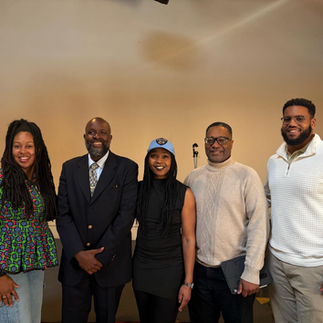
On February 28, 2026, Black Sustainability, Inc. and Black Man Green Plan partnered to bring the first Agrivoltaics Conference for Black Land Owners and Farmers, hosted at The Multi-Use Radical People's Hall (The MURPH) in Atlanta, GA, USA. At this conference, presenters Miles Braxton (Okovate Sustainable Energy), Knowledge Murphy (Black Man, Green Plan), Christian Warren (Midflare Corporation), and Raina Turner-Greenlea (Black Sustainability) shared how agrivoltaics can help many Black farmers and landowners can sustain their futures by harnessing the power of the sun and utilizing their land in multiple ways. We send much gratitude to those who attended virtually and in person.
What is Agrivoltaics?
Agrivoltaics, as defined by The Institute for Energy Economics and Financial Analysis, is the dual-use integration of solar panels and active farming on the same land. Dual-use is the most exciting part–farmers can produce food for markets and/or livestock and retain their land while growing a new stream of income through solar leasing.
In order for the US to reach solar goals, 83% of traditional/existing farmland will need to transition to solar farming. Because conventional solar leasing is not integrated into farm production and other land-use, the transition to solar typically leads to reduction of food security, farmer displacement, soil erosion, and other ecological degradation. There’s an immediate loss in farm productivity and a long-term loss in the overall health of the farmland. Done properly, agrivoltaics has the potential to eliminate those challenges by integrating energy and agriculture to increase revenue per acre.
Conference Notes
Knowledge Murphy kicked off the conference grounding why this work was so important and the opportunities our community consistently miss out on due to a lack of knowledge exchange. He shared the technical basis and benefits of solar and agrivoltaicsa couple examples of agrivoltaics at Universities. The University of Oregon made money on the solar panels while growing crops, saved money on water and irrigation, and made fertilizer from a process producing nitrous oxide. The University of Virginia installed anaerobic digesters which use bacteria to decompose organic matter in an oxygen-free environment and produce a methane-rich biogas that can be used as a renewable energy source.
Okovate’s approach to Agrivoltaics works with farmers, communities and developers to create clean energy projects that protect agriculture. Their commitment is to build a legacy for the farmers of tomorrow through agrivoltaics. Conference presenter Miles Braxton of Okovate says, “...we should think of agrivoltaics as welcoming a second tenant farmer onto your land — one harvesting sunlight above, while you continue harvesting crops below. The land stays in production. The farmer keeps control.”
Additionally, agrivoltaics increase shade which reduces heat stress on crops and livestock and have shown to increase organic matter in the soil.
Midflare discussed the increasing need for solar to support growth in population, automotive and data centers, and other electricity demands in the southeast US. This creates a big opportunity, but Midflare also pointed out some things to be sure to include in your agreement with developers. You want to be sure to include a reclamation bond–a financial instrument that ensures that, upon panel removal, your site is returned to the same state it was before solar was installed. You’ll want to watch for alteration of runoff patterns, for which you can hold the county accountable. You can also request an allowance of $2500 up front when you get a Letter of Intent to cover your legal costs.
For more information about our Alternative Energy Industry House, visit BlackSustainability.org.
Special thanks to our sponsors, Winston County Self-Help Cooperative and NRCS.




Comments